
Prevalence of extended spectrum β-lactamase and carbapenemase-producing ‘Escherichia coli’ and ‘Klebsiella pneumoniae’ in raw bulk cow milk from dairy cooperatives, Northwest Amhara, Ethiopia
EpiGen PhD student Chalachew Genet is the corresponding author of this paper:
Introduction: Extended spectrum β-lactamase (ESBL) and carbapenemase-producing Escherichia coli (E. coli) and Klebsiella pneumoniae (K. pneumoniae) emanating from raw cow milk are among the leading contributors to the spread of antimicrobial resistance (AMR). Due to the misuse and overuse of antibiotics in dairy farms, cow’s milk has become a reservoir of ESBL- and carbapenemase-producing E. coli and K. pneumoniae, posing a growing public health threat, especially in areas where the consumption of raw milk is common. However, compared to the clinical sector, the prevalence of ESBL- and carbapenemase-producing E. coli and K. pneumoniae in the food sector is understudied.
Objective: This study aimed to determine the prevalence of ESBL and carbapenemase-producing E. coli and K. pneumoniae in raw bulk cow milk from Dairy Cooperatives in Northwest Amhara, Ethiopia.
Methods: A cross-sectional study was conducted from January to April, 2025 among 257 dairy cooperative member farms. Sociodemographic and related data were collected using a structured questionnaire. Five millilitres of raw bulk cow milk were collected aseptically from each farm in four Dairy Cooperatives (DCs) (DC-A to D). 10 microliters of milk sample were directly inoculated into MacConkey agar. Escherichia coli and K. pneumoniae were identified using standard microbiological techniques. Antimicrobial susceptibility testing was performed using the Kirby-Bauer disk diffusion method. ESBL and carbapenemase production were confirmed phenotypically via combination disk tests and modified carbapenem inactivation methods, respectively.
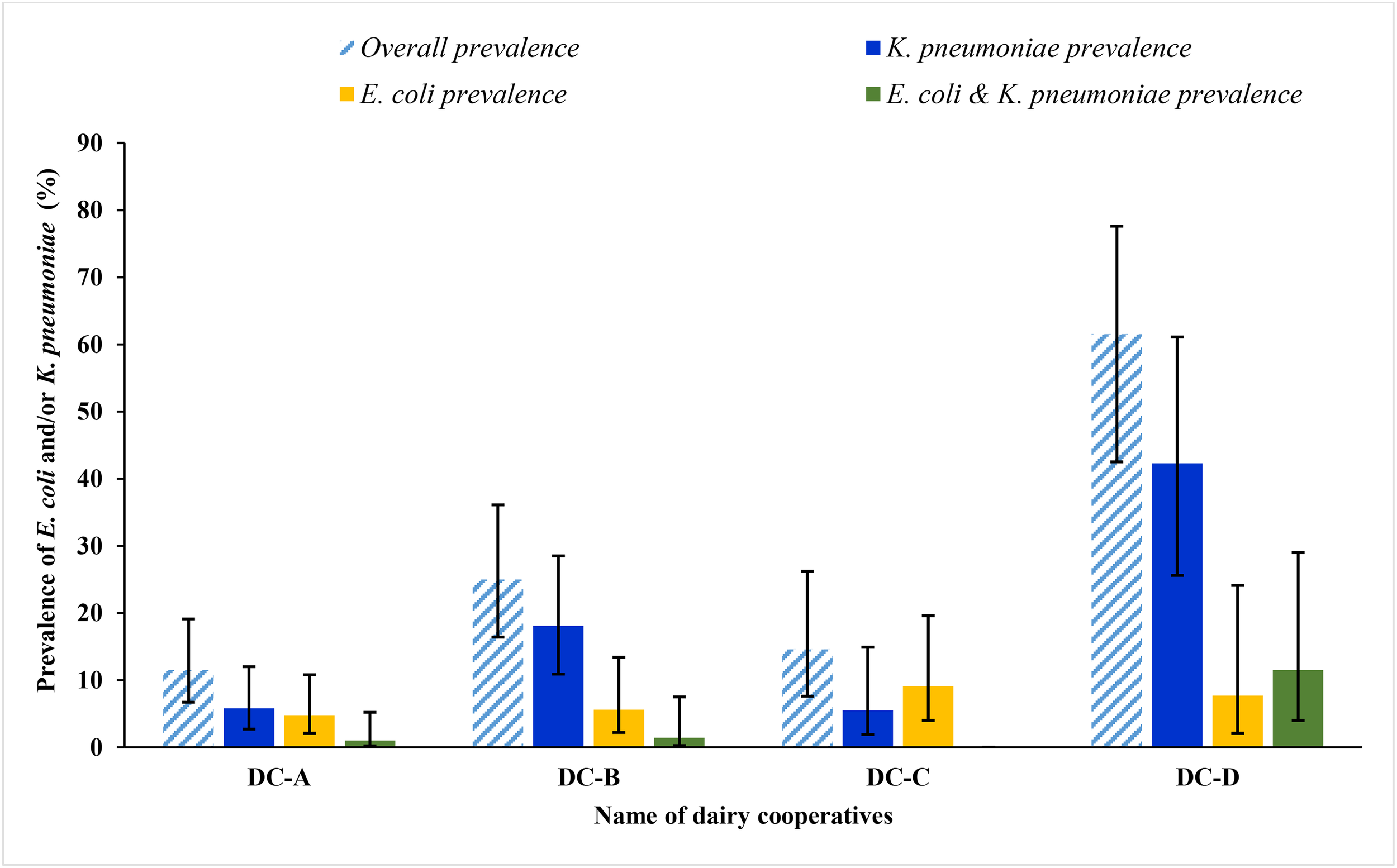
Results: The prevalence of E. coli and/or K. pneumoniae in raw cow milk was 21% (95% CI, 16.5–26.4%), with respective individual prevalence of 8.2% and 14.8%. ESBL-producing E. coli and K. pneumoniae accounted for 23.8% and 15.8% of isolates, respectively, while 2.6% of isolates (only K. pneumoniae) were carbapenemase producers. Resistance to ampicillin and amoxicillin-clavulanic acid exceeded 70%. All E. coli and 94.7% of K. pneumoniae isolates remained susceptible to carbapenems. Nearly half of all isolates (45.8%) were multidrug resistant (MDR), and 51.9% of MDR isolates were co-resistant to at least six antibiotics. Having additional non-farming occupations (AOR: 4.17, 95% CI: 1.49–11.67), large herd size (AOR: 3.21, 95% CI: 1.26–8.18), having pet animals (AOR: 6.53, 95% CI: 1.39–30.7), and use of calabash milk pail (AOR: 7.37, 95% CI: 1.45–37.49) were significantly associated with milk culture positive result for E. coli and/or K. pneumoniae.
Conclusion: Raw milk in Northwest Amhara harbors ESBL and carbapenemase-producing E. coli and K. pneumoniae, posing a substantial public health risk coupled with MDR and resistance to critically important antimicrobials. Strengthened AMR surveillance, improved farm hygiene, restricted antibiotic use, and public education on milk safety are urgently needed.