
First PhD in the bag for EpiGen Ethiopia
In October, the EpiGen Ethiopia consortium celebrated a milestone in the fight against antimicrobial resistance (AMR) when Dr. Chalachew Genet successfully defended his doctoral thesis on the topic at Bahir Dar University.
Called a "silent pandemic", AMR is one of the greatest global health challenges of our time. It occurs when bacteria evolve to withstand the medicines designed to kill them. Standard treatments start to fail, making routine infections life-threatening.
Dr. Genet’s research investigated drug-resistant bacteria across hospitals, dairy farms, and rural environments in northwest Amhara state. By taking a "One Health" approach – examining how resistance spreads between humans, animals, food, and nature – his work provides local health officials and farmers with vital evidence to protect their communities. Dr. Genet is the first of EpiGen Ethiopia’s 17 doctoral candidates to graduate.
"Antimicrobial resistance does not respect boundaries between humans, cattle, food, and the environment," he explained. "Drug-resistant bacteria are bacteria that have developed the ability to survive antibiotics that would normally kill them or stop their growth, making infections more difficult to treat."
‘Resistance does not respect borders’
Addressing a global threat requires global teamwork. Dr. Genet’s doctoral journey brought together clinical and microbiological expertise from Ethiopia alongside advanced genomic and bioinformatics support from international partners at Heinrich-Heine University in Germany.
Dr. Anna Rommerskirchen, an international collaborator and co-supervisor from Heinrich-Heine University, stresses why these cross-border connections are essential to EpiGen’s mission:
"We all know that AMR does not respect borders, so the capacity to detect and understand AMR and its related mechanisms cannot be concentrated in only a handful of well-resourced settings."
Strengthening sustainable capacity in Ethiopia
Beyond publishing four peer-reviewed scientific papers, Dr. Genet’s work achieved something far broader: establishing the routine use of whole-genome sequencing locally at the Amhara Public Health Institute in Bahir Dar. Local researchers can now sequence bacterial DNA in Ethiopia to track disease outbreaks in real time.
For Dr. Alemtsehay Mekonnen, EpiGen Ethiopia site principal investigator at Bahir Dar University, this signals a transformative shift for regional public health.
"In the longer term, I see Chalachew’s achievement as an example of what EpiGen is trying to build: not simply individual researchers or publications, but sustainable research capacity in Ethiopia. When we invest in talented young researchers and give them access to the right infrastructure and mentorship, they can generate high-quality science locally, train others and contribute evidence for surveillance and public health decision-making."
World-class science belongs everywhere: Dr. Genet’s achievement is a success for local research, equitable partnerships, and global health research. – Dr. Lauren Fromont
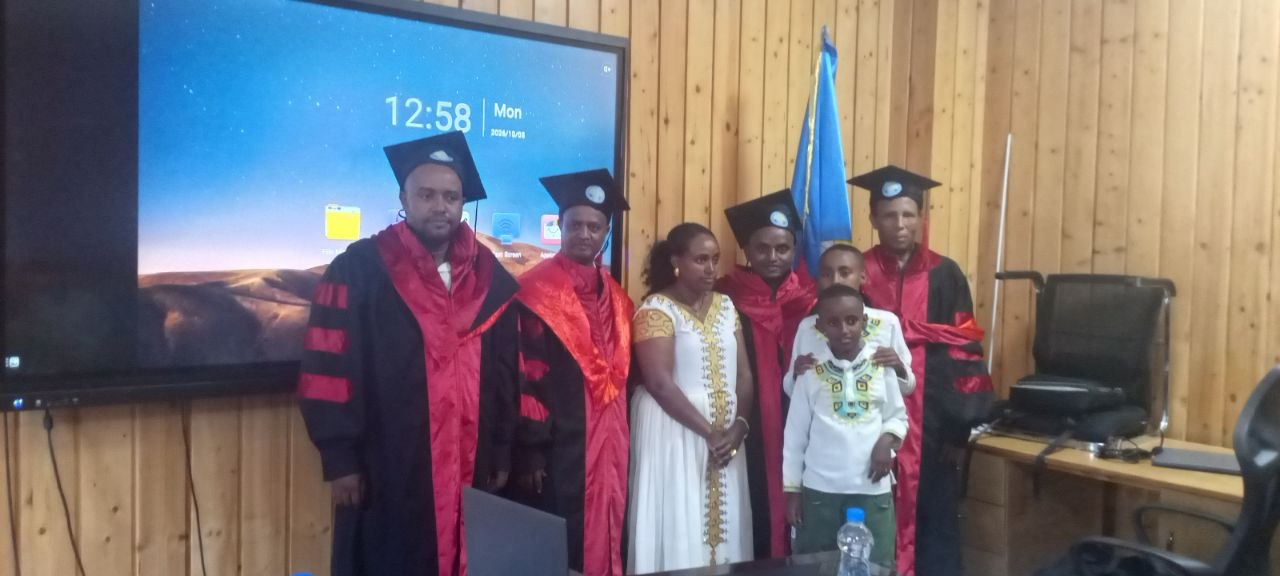
Dr. Chalachew Genet (fourth from the left) together with this family, examiners, and supervisor after successfully defending his PhD thesis on 6 October 2026. On the left is Dr Wondemagegn Mulu (internal examiner: Bahir Dar University) and Dr Woldaregay Erku (extenal examiner from Addis Ababa University), while Prof Abaineh Munshea (supervisor) stands on the far right.